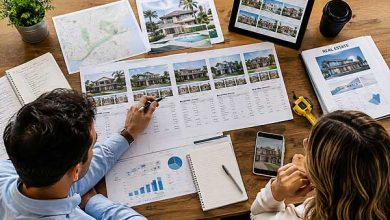

Pricing your home right is one of the most important decisions you’ll make when selling. Set the price too high, and your listing can sit for months. Set it too low, and you risk leaving money on the table. The goal is to find a price that attracts buyers while giving you the best opportunity to achieve a strong sale price.
Here’s how to find that perfect number.
Understand What “Market Value” Really Means
Market value isn’t what you hope your home is worth — it’s what buyers are willing to pay based on current conditions.
It’s shaped by three main factors:
- Comparable sales (comps): Homes similar in size, location, and condition that recently sold.
- Current inventory: How many homes are competing with yours right now.
- Buyer demand: How active buyers are in your area — often influenced by interest rates and seasonality.
A good real estate agent will analyze these data points to pinpoint your home’s realistic range. In hot markets, pricing slightly below the top of that range can spark competition and drive offers above asking.
Use Local Data — Not National Headlines
National housing trends make great news stories, but they rarely reflect your local market.
For example, while national prices might be cooling, your neighborhood could still be seeing bidding wars.
Check local MLS data, county property records, and recent neighborhood sales to understand what buyers are paying right now.
If you’re in a coastal Florida market like Vero Beach or Indian River County, waterfront homes may command a premium even when inland properties slow down.
Don’t Let Emotion Set the Price
It’s easy to overvalue your home because of memories or improvements you’ve made. But buyers don’t pay for sentiment — they pay for perceived value.
Ask yourself:
- Would a buyer see your upgrades as essential or personal taste?
- Are you comparing your home to others that truly match its size, age, and location?
A detached emotional view helps you price strategically, not sentimentally.
The Psychology of Pricing: Why “Charm Pricing” Works
Buyers shop for homes the same way they shop for everything else — emotionally first, logically second.
That’s why pricing at $499,000 instead of $500,000 can make a difference. It feels more approachable and fits better into online search filters (many buyers set maximums at round numbers).
Similarly, pricing just below key thresholds — like $299,000, $499,000, or $999,000 — can expand your audience and increase click‑throughs on listing sites.
Price for Online Visibility
Over 95% of buyers start their home search online.
Your price determines where your listing appears in search results. If you price outside common ranges, you might miss your ideal buyer entirely.
For example:
- A home priced at $505,000 won’t appear in searches capped at $500,000.
- A home priced at $499,900 will — and could attract multiple offers that push it higher.
Think of your price as a marketing tool, not just a number.
Consider Timing and Market Momentum
Pricing strategy changes with the season and market momentum.
- *Spring and early summer: High buyer activity — you can price closer to the top of your range.
- *Late fall and winter: Fewer buyers — competitive pricing helps maintain interest.
- Rising interest rates: Buyers’ budgets shrink, so homes priced aggressively may linger.
- Falling rates: More buyers enter the market, allowing slightly higher pricing.
*Keep in mind, location makes a difference! Your agent can help you read these signals and adjust accordingly.
Factor in Condition and Presentation
A well‑staged, move‑in‑ready home can justify a higher price.
If your home needs repairs or updates, buyers will mentally subtract those costs from their offer.
Before listing:
- Fix visible issues (peeling paint, leaky faucets, worn flooring).
- Stage rooms to highlight space and flow.
- Invest in professional photography — it’s often the difference between “scroll past” and “schedule a showing.”
Staging and presentation don’t just make your home look better — they make buyers feel it’s worth more.
Avoid the “Testing the Market” Trap
Many sellers start high, thinking they can always lower the price later.
But here’s the problem: the first 10–14 days are when your listing gets the most attention.
If buyers see your home sitting unsold, they assume something’s wrong — even after you reduce the price.
Overpricing can lead to:
- Fewer showings
- Longer days on market
- Lower final offers
Pricing correctly from day one creates urgency and confidence among buyers.
Use a Pricing Range, Not a Fixed Number
Instead of locking into one price, think in terms of a strategic range.
For example, if comps suggest $480,000–$500,000:
- List at $489,900 to attract attention.
- Expect offers between $485,000–$495,000.
This approach gives flexibility while signaling value.
Reassess Quickly if Activity Is Low
If your home hasn’t had showings or offers within the first few weeks, don’t wait months to adjust.
The market speaks quickly — and silence is feedback.
A small price reduction (2–3%) can reignite interest and bring your listing back into buyers’ search results.
It’s better to adjust early than chase the market downward later.
The Bottom Line: Price Smart, Not High
The goal isn’t to get the highest listing price — it’s to get the highest sale price.
Homes priced strategically sell faster, attract more buyers, and often end up closing above asking.
When you combine:
- Local data
- Professional insight
- Strong presentation
- Smart pricing psychology
…you create the perfect environment for a fast, profitable sale.
Pro Tip for Sellers
Before setting your price, ask your agent for a Comparative Market Analysis (CMA) and review recent pending sales — not just closed ones. Pending listings reveal what buyers are paying right now, which is often more valuable than last month’s data.